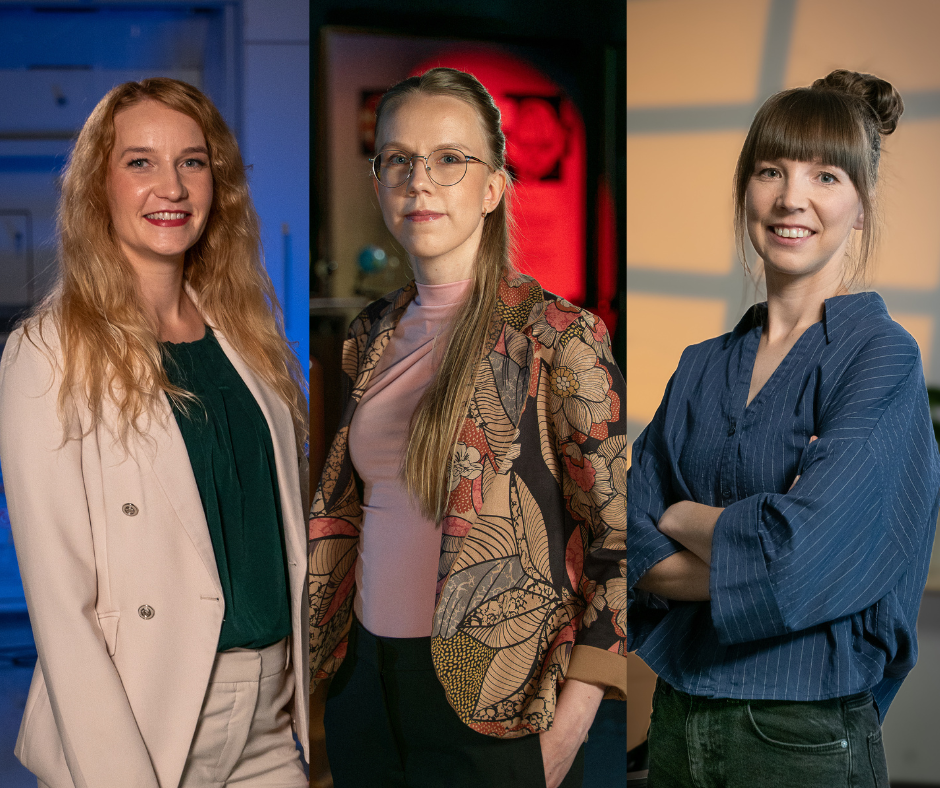
Pilleriin Peets, Anni Kasikov and Liina Malva are the Estonian recipients of this year’s Women in Science Baltic Fellowships, awarded by the academies of sciences and UNESCO National Commissions of the Baltic States.
They receive the fellowships of €7,000 in recognition of their research so far and to support further research in their scientific field.
The joint award ceremony for the Baltic laureates will take place next Thursday, 1 October, starting at 13:00 at the Estonian Academy of Sciences in Tallinn and will broadcast live on the website of the Academy.
Dr. Pilleriin Peets (University of Tartu) won the fellowship in the category of Doctor of Sciences in the fields of natural sciences, engineering and technology, medical and health sciences, agriculture and veterinary sciences. Her research focuses on developing better methods and tools to identify and understand the composition of the complex chemical systems that surround us – from textile fibres and dyes to environmental contaminants and biological metabolites.
Natural environments containing animals, plants, fungi and microbes are particularly complex, as they can contain tens of thousands of different chemical compounds at the same time. Non-targeted high-resolution mass spectrometry makes it possible to search for as many different compounds as possible in a sample, rather than only for predefined substances. It is currently one of the most powerful approaches for analysing small molecules, but even this method cannot capture the full chemical diversity present.
Pilleriin Peets’s innovative and interdisciplinary research combines analytical chemistry and environmental studies with machine learning, artificial intelligence and computational methods to expand the range of chemical compounds that can be detected in measurements. To achieve this, she develops new analytical methods that enable complex chemical samples to be compared more effectively and improve the reproducibility of results.
Anni Kasikov (University of Tartu) won the fellowship in the category of Doctoral Candidate in the same fields. She studies massive stars with short and turbulent lives, whose mass is more than eight times that of the Sun.
These stars are characterised by strong stellar winds and eruptive mass-loss events, and their lives end in supernova explosions that shape the dynamics and evolution of galaxies. Massive stars pass through unstable phases during their evolution that are difficult but important to understand. Yellow supergiants and hypergiants represent such transitional stages, which last only tens of thousands of years and are therefore extremely rare.
Anni Kasikov leads a survey of rare yellow supergiants and hypergiants in the Milky Way, using data collected with the Very Large Telescope (VLT) in Chile’s Atacama Desert. She also uses archival observations from space telescopes. By studying the stars across a broad range of wavelengths, she can obtain a more complete picture of their life cycles, characterise their atmospheres, identify binary companions and investigate their surrounding environments.
Evolved stars eject large amounts of matter into interstellar space, creating a kind of time capsule around them that preserves information about previous mass-loss events. Reconstructing the life stories of these rare stars helps us understand the physical processes preceding supernova explosions and the formation of the chemical elements that make up our bodies. Anni Kasikov’s research is carried out through extensive international collaboration and also contributes to continuing Estonia’s long tradition of stellar research.
Dr. Liina Malva (Tallinn University) won the fellowship in the category of Doctor of Sciences in social sciences or humanities. Her research focuses on mathematics learning difficulties and differentiated instruction in general education schools.
In recent years, concerns related to the teaching and learning of mathematics have become particularly prominent in Estonia, including low examination results and shortages of subject teachers. Teachers’ workloads are further increased by increasingly diverse groups of learners, which may contribute to burnout. Research has identified differentiated instruction – adapting teaching to individual differences – as one way of supporting inclusive education, but its implementation remains challenging in everyday teaching practice.
Liina Malva examines differentiation holistically from the perspectives of students, mathematics teachers and special education teachers, assessing changes in students’ perceived inclusion, learning motivation and knowledge. She also analyses how the beliefs and skills of mathematics teachers and special education teachers develop when teaching students with mathematics learning difficulties. In collaboration with international researchers, she is also bringing dyscalculia as a specific learning difficulty more clearly into focus in Estonia’s educational and research landscape.
President of the Estonian Academy of Sciences, Mart Saarma noted that although opportunities for women in science have improved considerably over time, inequality has not disappeared. “Historically, women scientists have had limited access to universities, funding, publishing opportunities and leadership positions. Even today, women remain underrepresented in senior positions in several fields of research, while disparities persist in both success rates in obtaining research funding and citation rates. Underutilising the abilities of half the population narrows the pool of talented people, who are always in short supply.” At the same time, Saarma said that substantial progress has been made in many fields. “This is also demonstrated by the fact that between 1901 and 2025, women received 68 Nobel Prizes, 38 of them since 2000. The visibility of women in science influences whether girls and young women see a research career as a realistic option for themselves, particularly in science, technology, engineering and mathematics, where women are less represented.” Saarma emphasised that although many women embark on research careers, they leave them more often than men do. “This is why the Women in Science fellowship is particularly important: it supports the careers of women researchers and increases their visibility.”
Renno Veinthal, Deputy Secretary General at the Ministry of Education and Research, noted that although women slightly outnumber men in Estonia’s research system, men are more likely to reach senior academic positions. “Hopefully, these fellowships and role models will encourage women to set their sights higher and be more ambitious in progressing from researchers to leaders and decision-makers,” Veinthal said.
In total, 44 women scientists applied for the three scholarships: 15 doctoral students and 29 researchers with a doctoral degree.
The aim of the joint fellowship is to support and ignite young women scientists in their pursuit of a career in science in the Baltic States. Estonian fellowships are funded by the Ministry of Education and Research.
Watch from the videos, how the laureates are introducing their research projects. Photos of the laureates (by Martin Mae).
Short overviews of Latvia’s and Lithuania’s “Women in Science” laureates
Latvian laureates (48 applications: 31 PhD level, 17 doctoral students):
- Dr. Arta Bārdule (Latvian State Forest Research Institute “Silava”) studies how reducing the tillage intensity of organic matter-rich agricultural soils affects greenhouse gas emissions.
- Dr. Vanda Haferberga (University of Latvia) studies the technologies, provenance and distribution of Early Neolithic pottery in the territory of present-day Latvia.
- Aļisa Ponkratenkova (Riga Technical University) develops biodegradable polymer materials from renewable resources that could replace conventional fossil-based plastics and thereby reduce plastic waste and its environmental impact.
Lithuanian laureates (60 applications: 46 PhD level, 14 doctoral students):
- Dr. Judita Škulteckė (Vilnius Gediminas Technical University) conducts research that contributes to improving the sustainability of road infrastructure in Lithuania and Europe, focusing on the performance of bituminous binders, the durability of asphalt pavements, and the development of sustainable road infrastructure solutions.
- Dr. Jurgita Rimkevičienė (Vilnius University) studies differences in suicide rates and the implementation of suicide prevention measures across different regions of Lithuania in order to determine which measures can most effectively help prevent suicides.
- Aistė Pupiūtė (Kaunas University of Technology) develops advanced medical tools for cell cultivation and in vitro modelling, focusing on their practical application and the implementation of innovations in the life sciences sector.