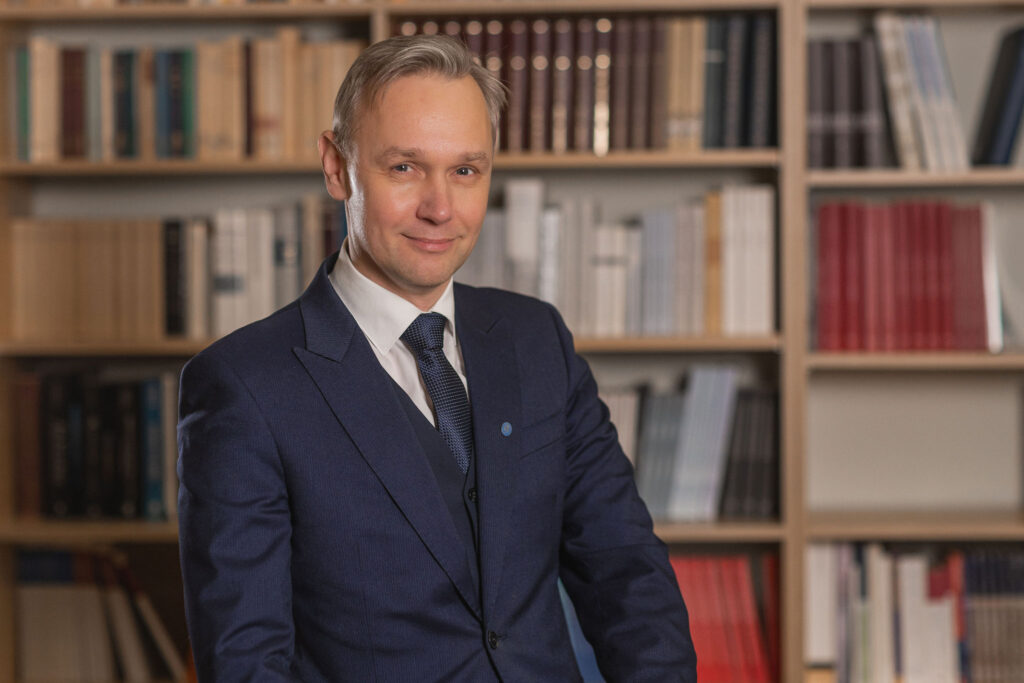
The Board of the Estonian Academy of Sciences appointed Academy Member Rainis Haller as the new Editor-in-Chief of Proceedings of the Estonian Academy of Sciences (PEAS).
Rainis Haller has been Professor of Mathematical Analysis at the University of Tartu since 2021 and a member of the Estonian Academy of Sciences since 2025. His research is rooted in mathematics, and he has a strong record of scientific leadership, having served as President of the Estonian Mathematical Society from 2018 to 2022. He has been a member of the PEAS Editorial Board since 2024, bringing continuity and a clear understanding of the journal's scope and values to his new role.
We sat down with Rainis Haller to learn more about his vision for the journal.
You have been part of the PEAS Editorial Board since 2024 – what motivated you to take on the role of Editor-in-Chief, and what do you bring to this position?
Proceedings of the Estonian Academy of Sciences has a long history and a special place among journals connected with Estonia and our wider region. I accepted the role because I believe PEAS has a strong foundation and good opportunities to strengthen its position as a selective Academy journal with a clear profile.
As a mathematician, I have learned to value precise questions, solid arguments, and clear writing. These are also important in editorial work. I want to support a fair and careful review process, and to help keep the journal focused on papers that genuinely belong in PEAS.
What is your vision for PEAS over the coming years, and how would you like to see the journal develop, both in terms of scientific scope and its visibility within the international research community?
I would like PEAS to be recognised as a selective journal of the Estonian Academy of Sciences. The journal should have a broad but well-defined scope and publish strong research in fields represented at the Academy, with particular attention to work connected with Estonia, the Baltic region, and Northern Europe.
This does not mean that PEAS should become a local journal. The aim is to publish research that is relevant internationally, while also reflecting perspectives and topics where our region has something distinctive to contribute.
In practice, I would like to build on what PEAS already does well by inviting more review articles and perspective papers, and by developing thematic contributions when they can bring together strong papers on a well-defined topic.
PEAS publishes original research across a wide range of disciplines. How do you approach the challenge of managing such broad disciplinary breadth, and what does a strong multidisciplinary journal mean to you?
A broad scope only works if the journal remains coherent. PEAS should not be simply a collection of papers from different disciplines. For every submission, the key question is simple: why should this paper appear in PEAS?
Rigorous peer review by specialists is essential, but it is not the whole story. The journal also needs careful editorial judgement at an early stage: whether a manuscript fits the profile, whether it has sufficient quality and relevance, and whether PEAS is the right place for it.
That is why I describe PEAS as a selective Academy journal with a broad but well-defined scope. The ‘Academy’ part should mean two things: high disciplinary standards and a wider perspective. The journal should publish papers that are not only technically sound but also meaningful beyond a very narrow specialist circle.