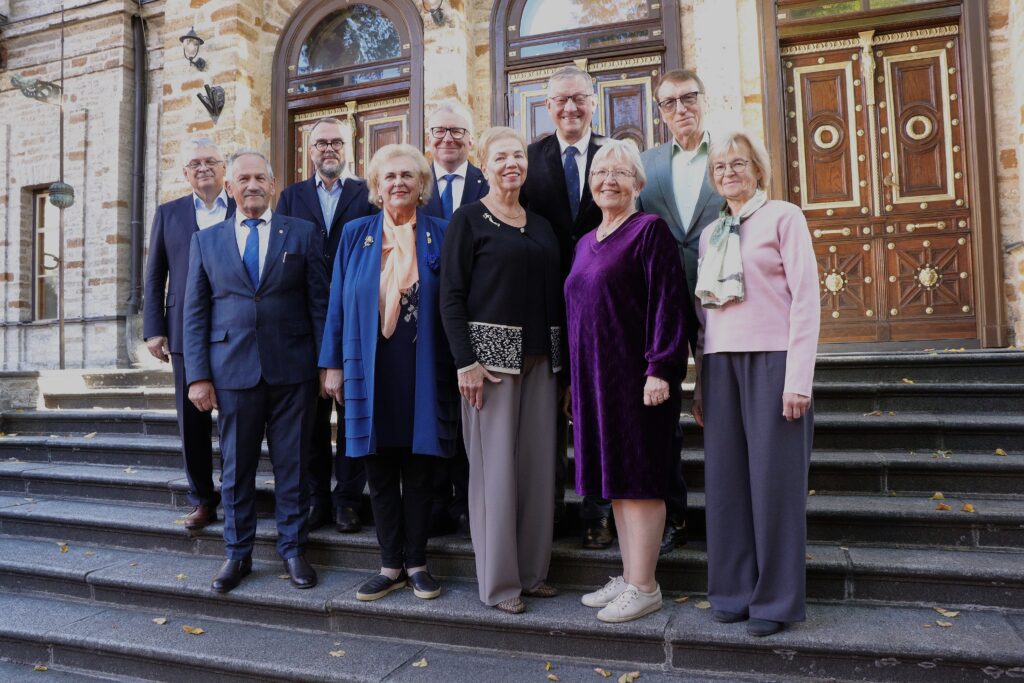
Today, the leadership of the academies of sciences of the three Baltic States met at the Estonian Academy of Sciences to present their activities and discuss opportunities for cooperation and shared interests. During the meeting, the presidents of the academies also signed a joint statement strongly condemning the Russian drone strike on the historic building of the National Academy of Sciences of Ukraine in central Kyiv.
Representatives of the three academies presented their organisational structures, principles for electing members, and main objectives.
The Estonian Academy also shared its experience of how its Standing Committee on Cyber Security has contributed over its three years of operation to improving the cybersecurity risk analysis of e-services in Estonia. The Academy also presented its event series “Dialogue of Sapience and Authority on Toompea”, which over the past two years has brought together researchers, experts and politicians to discuss issues of national importance.
The Lithuanian Academy presented its plans for two events to be held in 2027. In March, the Human Rights and Science Symposium is planned to take place in Vilnius in cooperation with the German National Academy of Sciences Leopoldina, focusing on strengthening the autonomy, integrity and capacity to act of research institutions, as well as on risk prevention. In May, Vilnius will host the 20th Baltic Conference on Intellectual Cooperation (BCIC 2027), “Nanomaterials and Nanotechnology Through Time: Past Insights, Present Advances, Future Directions”.
President of the Estonian Academy of Sciences Mart Saarma noted that the Baltic States are connected by both geographical proximity and similar developments over recent decades. “Since regaining independence, all three of us have maintained close cooperation with the Nordic countries and Poland, while relations among ourselves have received less attention. Now is the time to strengthen our cooperation, as we all have strengths to share – Latvia in the chemical and pharmaceutical industries, Lithuania in biotechnology, and Estonia in information technology and its biobank. The future of all three countries depends on how successfully we can adopt new technologies. Cooperation between our academies is natural, as in all three countries the academies promote basic research hand in hand with applied research.”
In the joint statement, the presidents of the Baltic academies describe the Russian attack as part of a broader pattern in which Ukrainian universities, research institutes and other civilian infrastructure have repeatedly been damaged or destroyed. They call on international scientific organisations to suspend the participation of Russian state research organisations in international scientific projects and committees for as long as Russia continues its war of aggression against Ukraine. They also affirm that the Baltic States will continue to support Ukrainian science.
More photos from the meeting can be found here.