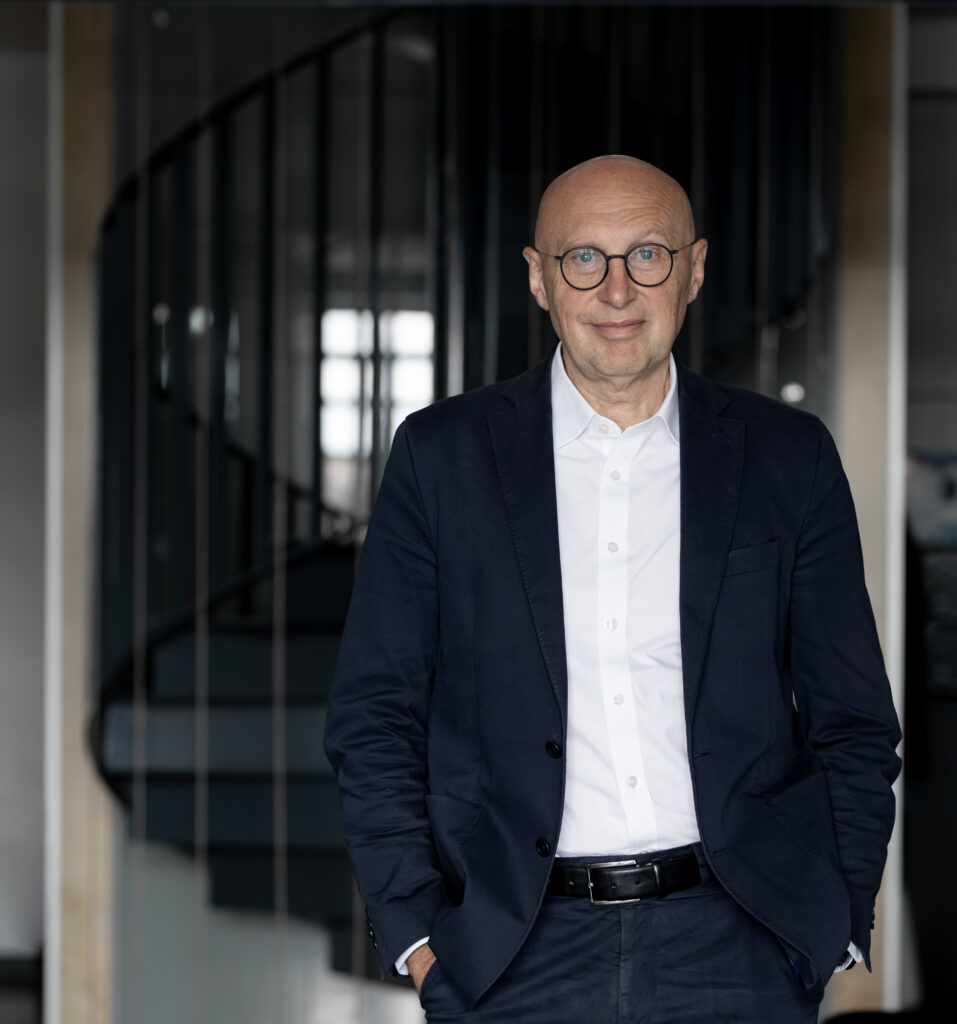
On 8 October 2026, world-renowned physicist and Nobel laureate Stefan W. Hell will receive the Endel Lippmaa Memorial Medal at the Estonian Academy of Sciences in Tallinn.
The medal will be presented by the President of the Republic of Estonia, Alar Karis, at a ceremony beginning at 4:00 p.m. The ceremony will be followed by a lecture “How to Overcome a Supposed Scientific Barrier and What to Make of It?”, by Professor Hell.
The event will be streamed live on the Estonian Academy of Sciences website. In-person attendance is by invitation only.
The development and application of new scientific methods was a hallmark of Endel Lippmaa’s research. This same pioneering spirit is at the heart of Stefan W. Hell’s work. By challenging what had long been regarded as a fundamental limit of optical microscopy, Hell developed a groundbreaking approach that made it possible to observe structures at the nanoscale. In recognition of this achievement – turning what was once thought impossible into reality – he will receive the 2026 Endel Lippmaa Memorial Medal.
Stefan W. Hell was awarded the 2014 Nobel Prize in Chemistry, together with Eric Betzig and William E. Moerner, for the development of super-resolved fluorescence microscopy. For more than a century, the resolution of optical microscopy was thought to be fundamentally limited by the diffraction of light. Hell challenged this long-established assumption. In the 1990s, he developed the concept of stimulated emission depletion (STED) microscopy, demonstrating that fluorescence microscopy could achieve resolution far beyond the conventional diffraction limit. His pioneering work helped establish the field of super-resolution fluorescence microscopy, or nanoscopy, allowing scientists to observe structures and processes at the molecular scale with unprecedented detail. These techniques have opened up new possibilities in biology and medicine, enabling researchers to study living cells, cellular structures and rapid biological processes with extraordinary spatial and temporal resolution.
The Endel Lippmaa Memorial Medal and accompanying lecture series honour the legacy of Academy Member Endel Lippmaa. Through this tradition, the Estonian Academy of Sciences seeks to promote scientific excellence and the exchange of new ideas, while recognising exceptional individuals whose work has made a lasting contribution to Estonia and beyond. The Endel Lippmaa Memorial Medal is awarded to an outstanding figure in science or public life whose work has significantly advanced science or society and who embodies the values that characterised Endel Lippmaa’s own career: scientific excellence, innovation and a strong commitment to serving society.
The recipient of the Endel Lippmaa Memorial Medal is selected by a committee comprising Mart Saarma, President of the Estonian Academy of Sciences; physicists and Academy members Ene Ergma and Marco Kirm; Endel Lippmaa’s son, Mikk Lippmaa; and Urmas Nagel, former Director of the National Institute of Chemical Physics and Biophysics, which Endel Lippmaa was instrumental in establishing.
The Endel Lippmaa Lecture Fund Committee is chaired by Riivo Sinijärv, Member of the Management Board of Kemotex Finance OÜ.
The first Endel Lippmaa Memorial Medal was awarded in 2017 to Nobel laureate in Chemistry Kurt Wüthrich. The second recipient was the distinguished Danish statesman and long-standing friend of Estonia Uffe Ellemann-Jensen.
Event webpage
Stefan W. Hell will give a guest seminar for students and researchers at Tallinn University of Technology (TalTech), entitled “Molecule-Scale Resolution and Dynamics in Fluorescence Microscopy” on October 9, at 11 a.m. More information here.