At the general meeting of the Estonian Academy of Sciences, three new foreign members were elected: Frede Blaabjerg, Professor of Power Electronics at Aalborg University; Johanna Laakso, Professor of Finno-Ugric Languages at the University of Vienna; and Virginijus Šikšnys, biochemist and Professor at Vilnius University.
Frede Blaabjerg is one of the world’s leading researchers in the fields of renewable energy systems, power electronics, and energy efficiency. His work has had a significant impact on the development of sustainable energy technologies. As a pioneer in integrating renewable energy sources into modern energy systems, he has made a remarkable contribution to the development of wind and solar energy solutions, helping to improve their reliability and performance.
He is the most highly cited researcher in the world in the field of electrical and electronic engineering, his work has shaped modern power electronics and leaded the development of the entire field.
Professor Blaabjerg has collaborated with Tallinn University of Technology for over two decades, publishing numerous joint papers with Estonian scientists and contributing to the international development, research capacity, and networking ability of Estonian engineering.
As an honorary doctor of Tallinn University of Technology, he has supported the growth of Estonia’s academic community by participating in international scientific conferences organized by the university and contributing to doctoral schools held in Estonia. He has helped to shape the next generation of Estonian scientists and engineers and to strengthen the internationalization and quality of doctoral studies.
He has been awarded the prestigious Edison Medal of the Institute of Electrical and Electronics Engineers (IEEE) and has served as President of the IEEE Power Electronics Society.
Johanna Laakso is one of the most prominent and active internationally recognized researchers and lecturers in Finno-Ugric languages, who has made a valuable contribution to international linguistics as well as to Estonian humanities and culture.
Although her research initially focused on the Baltic Finnic languages, she has later published articles on a wide range of historical and theoretical topics concerning Uralic languages, with particular emphasis on language contact. The breadth of her research is well illustrated by the more than 1,000-page work “The Oxford Guide to the Uralic Languages” (2022), of which she was one of the editors and contributors.
Professor Laakso’s willingness to collaborate with Estonian research institutions and her interest not only in the purely linguistic aspects of written culture but also in literary aspects have been remarkable. She is a polyglot and an admirer of Estonia who speaks Estonian well. Already as a student, she translated Friedebert Tuglas’s “Marginalia” into Finnish, which was published as a special edition for the writer’s 100th anniversary.
She is also a member of the Finnish Academy of Science and Letters, the Austrian Academy of Sciences, and Academia Europaea.
Virginijus Šikšnys is an internationally recognized biochemist and molecular biologist whose scientific discoveries have contributed to the development of precise gene-editing methods, which are of great importance in agriculture, medicine, biotechnology, and fundamental biology.
Professor Šikšnys gained international recognition through his work on the CRISPR-Cas9 gene-editing technology, published in 2012, which enables genetic material to be modified more precisely, quickly, simply, and efficiently than before. At the same time, similar results were reported by Emmanuelle Charpentier and Jennifer Doudna. In 2018, all three received the prestigious Kavli Prize in nanoscience.
Virginijus Šikšnys’s research contributes to the development of new medicines and diagnostics and supports the growth of startups and research-based entrepreneurship, including Estonia’s biotechnology and health technology sectors. The technology developed by him is actively used by both the University of Tartu and Tallinn University of Technology.
In addition to his scientific work, Virginijus Šikšnys is also an outstanding scientific leader. He is a member of Academia Europaea, the Lithuanian Academy of Sciences, the Norwegian Academy of Science and Letters, and the European Molecular Biology Organization (EMBO), and he serves as Chair of the Council of the European Molecular Biology Laboratory (EMBL), one of the most influential positions in European molecular biology.
Foreign members of the Academy are selected from among international scientists who have outstanding achievements in their field and whose research is connected to Estonia. With the newly elected members, the Estonian Academy of Sciences now has a total of 22 foreign members.
The Estonian Academy of Sciences Elects Three New Foreign Members
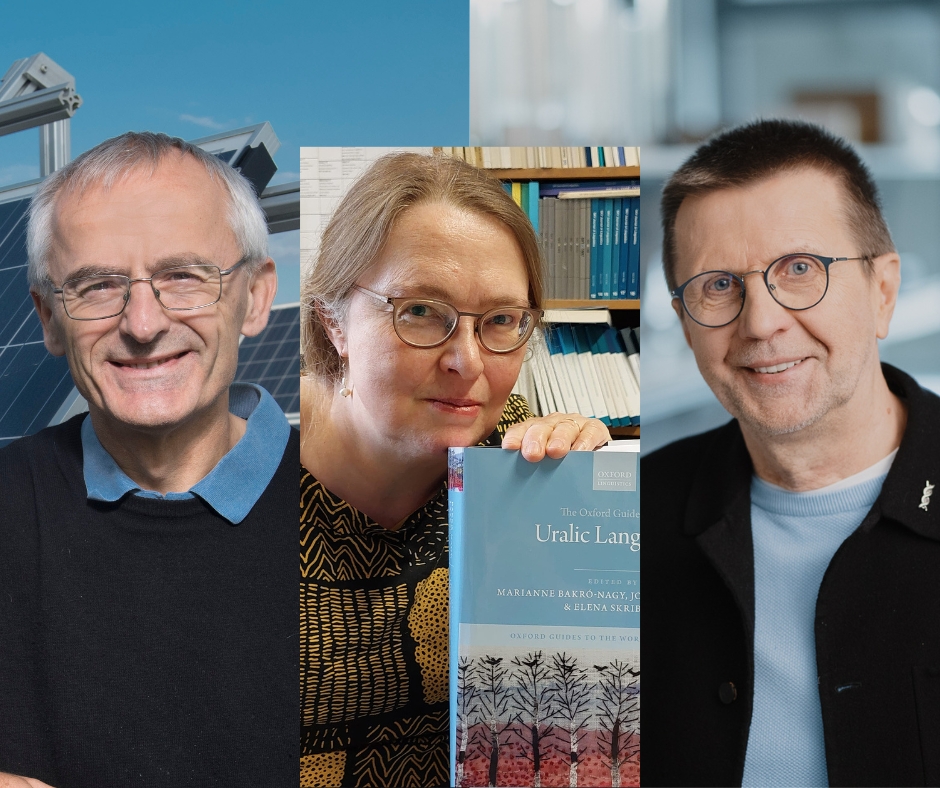
From left to right: Frede Blaabjerg (photo by Lars Horn Baghuset), Johanna Laakso (photo by Mikko Kajander) and Virginijus Šikšnys (photo by Ugnius Bagdovaničius / University of Vilnius)