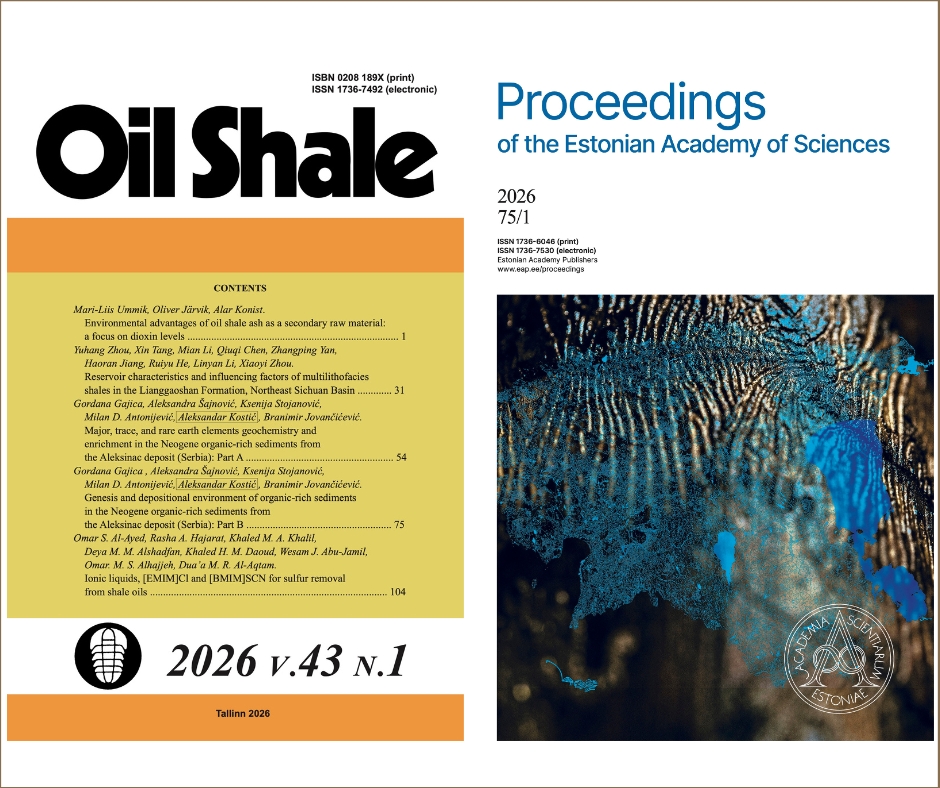
In March, the scientific journals Oil Shale and Proceedings of the Estonian Academy of Sciences were published.
OIL SHALE
The new issue of Oil Shale features four articles authored by researchers from Estonia, China, Serbia, and Jordan.
The article by Estonian scientists, ‘Environmental advantages of oil shale ash as a secondary raw material: a focus on dioxin levels’, presents a comprehensive analysis of dioxin levels in oil shale ash originating from different facilities and combustion conditions. Although dioxins are often considered hazardous by-products of combustion processes, the study shows that their concentrations in oil shale ash remain below detection limits and far below regulatory thresholds, even when applying the upper-bound approach in the worst-case scenario. These results highlight the considerable potential of oil shale ash as a safe secondary raw material for applications in construction, agriculture, and resource recovery.
Another noteworthy contribution is the article by Jordanian authors, ‘Ionic liquids, [EMIM]Cl and [BMIM]SCN for sulfur removal from shale oils’. In this study, oil shales from Attarat and Sultani were pyrolysed at 550 °C to produce shale oils with organic sulphur contents of 9.3 and 10.5 wt%, respectively. The researchers applied liquid–liquid extraction using two ionic liquids, [EMIM]Cl and [BMIM]SCN, and achieved sulphur removal efficiencies exceeding 50%. The study also demonstrates that extraction temperature plays a significant role in the desulphurisation process.
We invite readers to explore these and the other articles featured in this issue.
PROCEEDINGS OF THE ESTONIAN ACADEMY OF SCIENCES
Celebrating its 75th volume this year, the March issue of the Proceedings of the Estonian Academy of Sciences features seven articles by researchers from Estonia and abroad. The contributions span a wide range of topics, from control theory and quaternary wastewater treatment to food microbiology, cell biology, communication and computing networks, as well as studies on blackcurrant genotypes, and the properties of Estonian local sheep wool.
The article ‘Revaluation of Estonian local sheep wool – impact of different wool types on textile material properties’ by Liisa Torsus and co-authors examines the potential of Estonian local sheep wool for high-quality textile production. The study analyses specific fibre properties and evaluates their combined effects on yarn, knitted material, and knitted felted material. Compared to locally raised Mérinos d’Arles wool, fibres from the wool of the Estonian breeds were more uneven, coarser, and longer, with higher linear density and lower cuticle scale frequency. However, yarns produced from these fibres demonstrated greater tensile properties. The findings highlight the importance of revaluing local wool and its potential for producing textiles from it.
The article ‘Evaluation of seed content and fatty acid profile in blackcurrant (Ribes nigrum L.) genotypes’ by Viive Sarv and co-authors investigates 22 blackcurrant genotypes over two years. The aim of the research was to compare berry weight, seed content in the berries, and fatty acid profile in the seeds. The composition of fatty acids was identified and quantified using gas chromatography. The results showed that blackcurrant berry weight varied from 1.0 to 1.7 g, seed content ranged from 2.2 to 4.6%, and oil content correlated positively with the proportion of seeds per fresh weight of berries. Linoleic acid was the most abundant fatty acid in seeds, followed by α-linolenic, oleic, and γ-linolenic acids. Seed content is an important factor in cultivar selection and breeding programmes. Understanding the genetic basis for the variation of seed content can help develop blackcurrant varieties that meet specific market demands. In addition, more detailed knowledge of blackcurrant berry composition may open new opportunities to use juice production by-products in the food and cosmetic industries or in animal nutrition, while supporting environmental sustainability and resource efficiency.
Additional information:
Subscribe to journal alerts on our website to get notifications of new issues.
Estonian Academy Publishers welcomes new manuscripts. Find more information here.