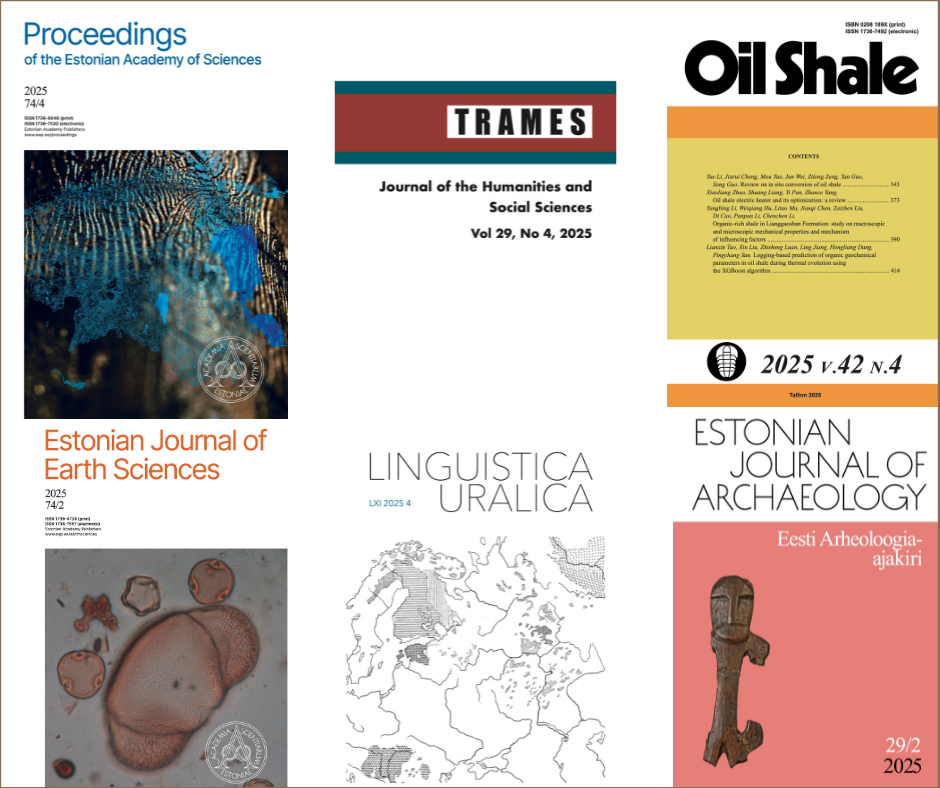
New issues of the scientific journals Estonian Journal of Archaeology, Estonian Journal of Earth Sciences, Linguistica Uralica, Oil Shale, Proceedings of the Estonian Academy of Sciences, and TRAMES have been published.
ESTONIAN JOURNAL OF ARCHAEOLOGY
The second issue of Estonian Journal of Archaeology in 2025 contains three important articles.
Raivo Suni together with his colleagues from different institutions provides the first full map of bioavailable strontium in Estonia, based on the 87Sr/86Sr ratio of bioavailable strontium collected from 84 rodents and snails across 38 locations. The strontium isoscape of Estonia is needed for archaeological and palaeoecological research as it helps to study the provenance and mobility of ancient humans and animals. The analysis identified two clearly distinct isotopic areas in relation to Estonia’s bedrock composition: (1) coastal and central Estonia, including the West Estonian archipelago, where bedrock is composed of Ordovician and Silurian carbonate rocks and (2) southern Estonia, located predominantly on Devonian sandstone bedrock.
Kerkko Nordqvist discusses the problems concerning the emergence of Typical Comb Ware in Latvia, which is currently dated to approximately 4100 BC, i.e. several centuries earlier than the onset of this phenomenon in other regions. The evaluation of data shows that most dates previously connected with this phenomenon cannot be definitively associated with Typical Comb Ware material culture, or are affected by other issues, such as dietary offsets. It is proposed that the boundary for the beginning of Typical Comb Ware in Latvia should be more closely aligned with current understandings of the dating of this phase elsewhere in north-eastern Europe and should be set at 3900–3800 BC at the earliest.
Andres Tvauri studies the Pskov style earthenware, which was widely used in Estonia from the 11th to the 18th centuries concentrating on types 1–4 of the 11th–15th centuries. This pottery reached eastern Estonia during the period of 1030–1061, when Tartu was a stronghold of the Grand Princes of Kyiv. In the 13th century, this type of pottery spread more widely, mostly in eastern and southern Estonia, being related to the presence of Novgorodians and Pskovians in the hillforts of Tartu (1223–1224) and Viljandi (1223), and later to the arrival of craftsmen from Pskov in Tartu and Viljandi in the 1230s and 1240s. In the 14th–15th centuries, this type of pottery spread throughout mainland Estonia, except in western Estonia, and was most likely produced locally.
ESTONIAN JOURNAL OF EARTH SCIENCES
The latest volume of the Estonian Journal of Earth Sciences brings together a diverse set of studies spanning palaeoclimatology, palaeontology, sedimentology, hydrology, and applied geoscience.
The last issue of the year opens with a high-resolution reconstruction of late Holocene warm-season temperatures in southern Finland by Samuli Helama and co-authors, in which the integration of maximum latewood density records and historical plant phenology offers an exceptionally robust perspective on pre-industrial climate dynamics, refining our understanding of regional climatic trends since the Medieval Climate Anomaly.
Palaeontological research is represented by two contributions. A study by Tiiu Märss on Silurian to lowermost Devonian vertebrates from the Ufa Amphitheatre revises the taxonomy and biostratigraphy of key agnathan groups, strengthening biostratigraphic correlations with the East Baltic. Jeon and Toom report the discovery and description of Rosenella hosholmia sp. nov. from the Upper Ordovician of Estonia – the first record of this stromatoporoid genus in Baltica. This finding expands the palaeogeographic range of Rosenella and underscores the continued potential for significant discoveries within well-studied strata.
Ervīns Lukševičs and co-authors provide new sedimentological, palaeontological, and taphonomic insights from the Devonian Ketleri Formation of Latvia, shedding light on a tide-influenced delta system shaped by a strongly seasonal climate. The integration of basin modelling, trace-fossil evidence, and newly recognized plant macroremains reveals a complex, dynamic landscape at the close of the Devonian Period.
A study by Aldona Baubinienė of the Neris River documents how a decline in high-magnitude floods has facilitated vegetation encroachment and island expansion in the river’s lower course, with implications for future flood risk in a warming climate.
Enn Karro and co-authors evaluate the pharmaceutical potential of deep mineral water from the Gdov aquifer in Värska, Estonia, highlighting the potential of local mineral water resources for the development of hypertonic nasal/throat sprays and similar seawater-like products.
LINGUISTICA URALICA
In the current issue of Linguistica Uralica, Erika Asztalos from the ELTE Hungarian Research Centre for Linguistics presents a novel analysis of Udmurt deverbal, copulaless predicative forms derived with the suffix -(e)mi̮n. They underwent a typologically common grammaticalization cline from resultative, as in ukno uśtemi̮n ‘the window is open’, to passive and resultative, as in perepeć śiemi̮n anajen ‘the perepeč was eaten by mother’, and further to perfect and even past tense, as in so 1959-eti ari̮n bi̮remi̮n ‘s/he died in 1959’. In her article ‘Resultatives grammaticalizing into passives, perfects, and past tense forms in Udmurt’, she compares 19th century folklore data with contemporary corpus data. Her results show that while all examples in the old data can be analysed as resultatives, contemporary (e)mi̮n-constructions have a heterogeneous use, in which besides the resultative use some instances can be analysed as actional passives, others as perfects and still others as past tense forms.
OIL SHALE
The new issue of Oil Shale contains four articles, all submitted by researchers from China. Two of these are review papers focusing on in situ conversion technology for oil shale and will certainly be of interest to readers.
The first review article, titled ‘Review on in situ conversion of oil shale’, provides an in-depth discussion of various in situ conversion technologies for oil shale, including the in situ conversion process (ICP), Electrofrac, the Geothermic Fuels Cells (GFC) process, and supercritical water heating. The paper also examines the current state and development trends of in situ conversion technologies in China, emphasizing the importance of advancing fundamental research and overcoming key technological challenges to achieve large-scale utilization of oil shale resources.
The second review article, ‘Oil shale electric heater and its optimization: a review’, offers a comprehensive analysis of subsurface electric-heater technologies used for in situ oil shale conversion. It discusses their principles, characteristics, and limitations in detail.
We also encourage readers to explore the other articles in this issue, which focus on the development of novel methods for determining the physical and chemical properties of oil shale from various deposits.
PROCEEDINGS OF THE ESTONIAN ACADEMY OF SCIENCES
The December 2025 issue of the Proceedings of the Estonian Academy of Sciences includes nine articles by authors from Estonia and abroad. The articles cover topics such as scientometrics, mathematical physics and general relativity, topological algebras.
Jüri Allik, Mart Saarma and Anu Realo present an article ‘How did Estonia become the world’s fastest-growing country in scientific wealth’. This analysis is based on data from Essential Science Indicators (ESI; Clarivate™), which ranks authors, institutions, countries, and journals according to publication and citation performance between 2014 and 2024. Twenty years ago, Estonia’s scientific impact was 20% below the ESI world average. Today, the average citation rate of articles by Estonian researchers is 81.7% above the ESI world average, placing Estonia third globally, after Iceland and Singapore, and ahead of its Nordic neighbours and role models, Finland and Sweden. The rapid growth of Estonian science has yet to be fully explained. None of the four groups of factors analysed ‒ science policies, funding, foreign aid, and research ethos ‒ can fully explain Estonia’s success on its own, especially when compared to its Baltic neighbours, Latvia and Lithuania. Estonia is a prime example of how a fortunate combination of factors can lead to the fastest growth in scientific wealth worldwide, although this specific combination remains to be identified.
In the article by Jüri Engelbrecht, Kert Tamm and Tanel Peets, ‘Interdisciplinarity in modelling of biophysical processes’, the importance of interdisciplinary ideas for modelling and understanding signal propagation in nerve fibres is described as a fascinating problem of biophysics. A mathematical model involves the physical laws, assumptions, hypotheses, and finally, the governing equations. The analysis of this complex process is at the interface of physics, chemistry, and mathematics, together with experimental studies in electrophysiology. It is stressed that the mindsets of different communities may hinder cooperation.
TRAMES. A JOURNAL OF THE HUMANITIES AND SOCIAL SCIENCES
The first article is by Nilay Erdem Ayyıldız from Turkey, titled ‘Beyond the Hundred Acre Wood: posthumanism in A. A. Milne’s Winnie-the-Pooh’. Milne’s remarkable book Winnie-the-Pooh (1926) is set in posthuman space, the Hundred Acre Wood, inhabited in harmony by the human character Christopher Robin and his animal friends. The book sets a balance between the human and the nonhuman, culture and nature, reason and sensation. The paper examines how Winnie-the-Pooh illustrates the exercise of posthumanism in children’s literature, in order to show that the boundaries between the human and the nonhuman are blurred, how animal agency and nonhuman subjectivity in the book are constructed and how communication and nonhuman expressivity transgress anthropocentric language and rationalist discourse, by adopting a posthuman approach. The research thus shows that through stories for children Pooh helps to understand and realize posthumanism, transgressing the boundaries set by anthropocentrism in numerous Pooh-themed films by the Disney company.
Turkish researchers Emine Atmaca and Reshıde Gözdaş examine the traditional wedding rituals of South Crimean Tatars. These rituals constitute a number of colourful and entertaining events that take place in the home of the bride and groom and last three to seven days. The article aims to ascertain whether the traditions, habits, religious beliefs and ceremonies related to the Tatars’ marriage are still being continued.
The anthropological article by Indonesian scholars Ria Andayani Somantri et al. takes a look at Canoli (a woman), the guardian of sacred ritual banquets of Sunda Islands. The research uses Lévi-Strauss’s culinary triangle method. Cooking rice (raw at first, then the food is done) symbolizes the transformation from nature (raw) to culture (cooked). The ritual offerings of sacred banquets help to maintain social balance, strengthen hierarchy and community ties.
The paper by Armenian researchers Grigor Arshakyan et al. about the rivalry between Turkey and Russia in the Eurasian region continues the series of articles on developments on the great chessboard of Zbigniew Brzezinski. The differences in national interests in these two countries are mainly expressed in geopolitically sensitive areas, primarily in South Caucasus and the Middle East, where their overlapping spheres of influence escalate tensions.
In their article ‘Balancing act: self-leadership and the home work environment in remote work’, lecturers at the University of Tartu Anne Reino, Maaja Vadi, Kertu Mürgimäe and Eneli Kindsiko examine how remote workers balance the duality of home as a space for both living and working. The authors analyse the well-being, work habits and the features of people’s physical and virtual workspaces. The results show the complex dynamics of working from home: although workers value its flexibility and comfort, they also face various challenges, e.g. poor ergonomics, digital fatigue and social isolation.
Diana Poudel (University of Tartu), teacher and specialist in communication and digital literacy, examines how metaphors can improve our knowledge of media and information literacy. She analyses how the experts in Estonian academia, defence, media and education use metaphors to explain the main concepts of media and information literacy. The qualitative metaphor analysis produced five recurrent source domains: FOOD for production and consumption, WATER for flow and direction, NOISE for overload and interference, PLAYGROUND for cooperation and BATTLEFIELD for conflict. Careful and context-based metaphor choice improves teaching, public communication and policy, while careless usage of metaphors can oversimplify and in fact be harmful.
The last article is by Tanel Hirv (University of Tartu), ‘Challenges in Estonian research policy: a bibliometric perspective’. Over the past three decades, Estonian science has reached international recognition. Key drivers in this success have been joining the European Union, foreign funding and international collaboration. On closer inspection, however, many celebrated science achievements have proven overstated or methodologically questionable. The current article analyses Estonia’s scientific development using publication and citation metrics, authorship patterns and demographic data. It highlights the limitations of citation-based benchmarks for evaluating national research and questions the relevance of bibliometric percentile targets in science policy. The study also challenges the notion that the declining PhD graduation rates are primarily due to demographic changes, pointing instead to structural factors. The findings emphasize the need to reassess the role of bibliometric indicators in research policy and performance evaluation. As expected, Tanel Hirv’s article mainly quotes numerous articles by academician Jüri Allik on similar topics.
Additional information:
Visit our website and subscribe to journal alerts to receive notifications about the publication of new issues.
Estonian Academy Publishers welcomes new manuscripts. More information can be found here.