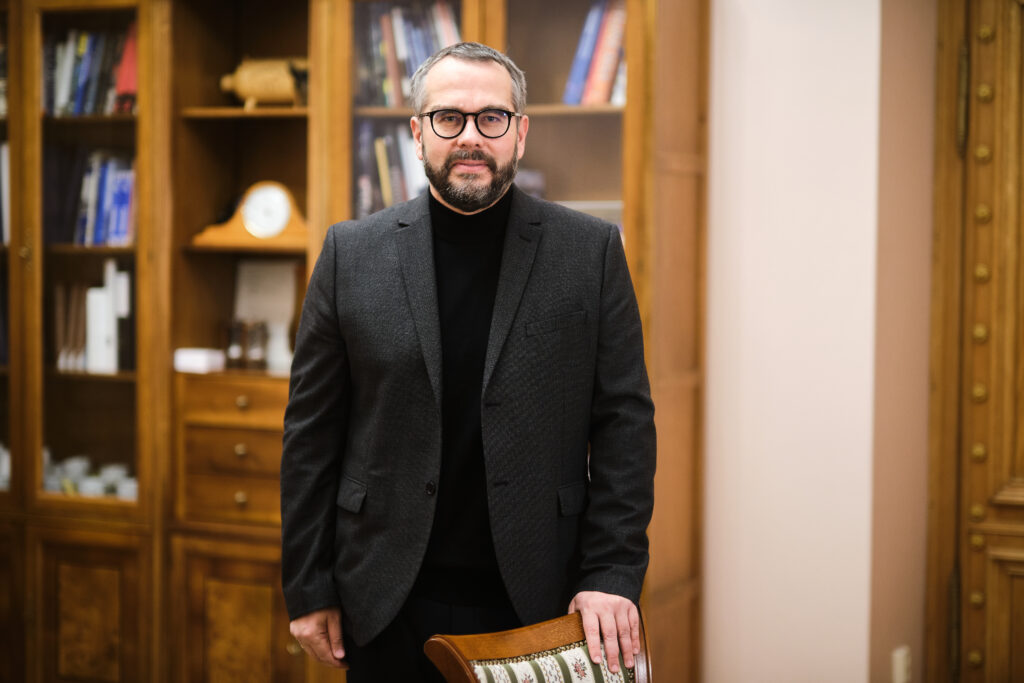
“A good editorial team does more than act as a gatekeeper – it also helps make an article better,” says Marek Tamm, a long-standing figure in academic publishing, Vice President of the Estonian Academy of Sciences, and Professor of Cultural History at Tallinn University. Next year marks 75 years since the Estonian Academy of Sciences published its first scholarly journal – a publishing tradition that, in a small country, has grown over the decades into a network of internationally recognised titles. We spoke to Tamm, who also chairs its Publishing Council, about the lessons learned from that tradition and where it goes from here.
You have chaired the Estonian Academy of Sciences Publishing Council since May this year. At the same time, you have known the publishing house from the inside for many years, not least as editor-in-chief of Acta Historica Tallinnensia. What do you see as the publishing house’s next major directions for development?
I don’t think the publishing house necessarily needs major changes. Rather, its existing work needs to be pursued even more systematically and professionally. We have a whole series of long-established, internationally recognised journals, and that provides a strong foundation on which to build. For the coming years, the key priorities for me are the automation of technical workflows, greater international visibility for the journals, and further standardisation of editorial practices. We also need to consider how to make a manuscript’s journey from submission to publication as straightforward and efficient as possible, without compromising quality. Part of this could involve adopting new platforms, such as OJS (Open Journal Systems – ed.) and SciFlow, which could help streamline the publishing process.
Over the years, you have been involved with a wide range of publishers and journals – Varrak, Tallinn University Press, Vikerkaar, the Journal of the Philosophy of History, and Acta Historica Tallinnensia. How has academic publishing changed over that period, and where is it heading now?
The biggest change, of course, is that academic publishing has become inherently digital and global. Just twenty-odd years ago, a journal was understood primarily as a printed periodical; today, the print issue is increasingly a by-product of a continuous digital publishing process, and it may not survive much longer as a distinct format. The second major change is open access – the expectation that research funded with public money should also be publicly accessible is, in my view, entirely justified. At the same time, the number of research articles published worldwide has grown enormously, making effective quality control ever more important. The pool of authors is certainly more international than before, and English has become even more dominant as the language of scholarship. This means that one of the tasks facing small research communities is to consider what we want to preserve of our own scholarly culture and scholarly language. In my view, internationalisation and the preservation of local scholarly culture are not mutually exclusive – a good academic publisher must be able to do both.
Estonia is a small country with a relatively small research community, yet the Estonian Academy of Sciences Publishers is responsible for a whole series of international scholarly journals. Is that a lot or a little for a country of Estonia’s size?
I’m not sure that the number of journals in itself tells us very much. The better question is whether each journal has a clear scholarly profile, a sufficiently strong community of authors and readers, and a competent editorial team. If these conditions are met, then eight scholarly journals under a single academic publisher is not a large number at all. For a small research community, having its own journals can be particularly important, since they make it possible to shape particular fields of research, bring together international research networks, and, in some cases, contribute to making sense of one’s own culture. At the same time, there is no point in keeping a journal going merely out of tradition – every journal must continually justify its existence and demonstrate its quality. The value of a scholarly journal is not determined by where it is published geographically, but by whether good researchers want to publish in it and whether other researchers want to read what it publishes.
The publishing house’s journals are internationally indexed and recognised, yet the wider public in Estonia may know relatively little about them. Should they be more widely known?
To begin with, it must be acknowledged that the primary task of a scholarly journal is not to be known to the wider public. Its main audience remains the international research community. But that does not mean that people in Estonia should be unaware that we have such a strong tradition of academic publishing – all the more so because several of the journals deal specifically with topics related to Estonia. In my view, we could do much better at communicating not so much the journals themselves as the interesting research findings published in them. Every journal publishes articles with broader social or cultural significance, yet this knowledge rarely reaches beyond the research community. This is an area in which the publishing house, the Academy, the universities, and science journalists could work together much more effectively than they currently do.
What role do Estonian universities play in the Academy’s publishing activities? Are they partners or, rather, competitors?
Partners, certainly. I see little reason to frame the relationship in terms of competition. The Academy’s journals are already produced in close cooperation with universities and other research institutions, and, for example, Proceedings of the Estonian Academy of Sciences is published in cooperation with several Estonian universities. For a small country, it would be rather pointless to build parallel systems alongside one another purely so that each institution could say it has its own journal or publishing house. Instead, we need to consider where resources, expertise, and international networks can be combined. One of the Estonian Academy of Sciences’ natural roles is precisely to serve as a meeting point across institutions. This principle could also be developed more deliberately in academic publishing.
Next year, the Academy’s tradition of academic publishing will reach an important milestone: it will be 75 years since the first issue of the Proceedings of the Academy of Sciences of the Estonian SSR was published, in 1952. At the same time, digitisation and artificial intelligence are changing publishing very rapidly. What does the future hold for scholarly journals?
In fact, this transformation has already taken place – a scholarly article is no longer simply a text placed in a journal issue and printed on paper. It is simultaneously a digital object, complete with a DOI, metadata, links, datasets, and various machine-readable layers. Proceedings, the successor to the former Academy’s Toimetised, is itself already published online on a continuous-publication basis: articles are made available as soon as they are ready. Artificial intelligence will accelerate this development even further: relevant applications can already be used for language editing, reference checking, metadata creation, and probably soon for many other technical stages of the publishing process as well. But I would be very cautious about claiming that artificial intelligence could replace the substantive work of an editor or reviewer. The central values of academic publishing are trust and responsibility, and responsibility cannot be delegated to an algorithm. Rather, technology can free people from more routine tasks so that they can devote more time to matters where human judgement is genuinely needed.
Is there an academic publisher or journal anywhere in the world from which the Estonian Academy of Sciences Publishers could learn in particular? And what do you read regularly yourself?
I wouldn’t name a single ideal model, since research fields and their publishing cultures vary a great deal. From the Academy’s point of view, it is of course instructive to look at the publishing traditions of long-established learned societies and academies, such as the Royal Society, and to consider how they combine centuries-long continuity with a constant capacity for renewal. Incidentally, the first issue of Philosophical Transactions appeared as early as 1665, and the journal is still published today, so the association between academies, learned societies, and scholarly journals has a very long history. The Estonian Academy of Sciences Publishers belongs to the network of European university presses, which provides an opportunity to learn from the experience of smaller, non-profit academic publishers. As for myself, I rarely read journals from cover to cover; instead, I follow particular authors and topics. Given my research interests, journals such as History and Theory, Rethinking History, Annales. Histoire, Sciences Sociales, the American Historical Review, the Journal of Medieval History, and Speculum regularly feature in my reading, as do journals on memory and cultural history. Nowadays it is probably more accurate to say that we no longer read journals so much as articles. Almost every day, I receive a table-of-contents alert from one journal or another; this is how I manage to keep up with the contents of dozens of scholarly journals on an ongoing basis.
What would you advise a young researcher who is considering submitting their first article to a journal published by the Estonian Academy of Sciences Publishers?
First of all, I would advise them not to base their decision on whether the journal is published in Estonia or abroad. The question to ask is whether it is the right journal for this particular article – whether it publishes similar research and whether it is read by the people with whom the author wants to enter into scholarly dialogue. If the answer is yes, then I see no reason to avoid Estonian journals. The Academy’s journals are internationally peer-reviewed, open access, and indexed in international databases. A young researcher’s first article is, in any case, an important learning experience – it is often their first sustained encounter with peer review, revision, and communication with an editorial team. A good editorial team does more than act as a gatekeeper; it also helps make an article better. And I certainly wouldn’t recommend choosing a journal solely on the basis of a single numerical indicator, such as the impact factor.
Looking even further ahead, what might the Academy’s journals look like when its first scholarly journal reaches its 100th anniversary in 2052?
First of all, I hope they still exist – but I don’t think they need to look exactly as they do today. It is likely that the journal issue as such will become less and less important, and that centre stage will be taken by a continuously expanding digital knowledge space in which articles are linked to data, sources, comments, and related research. The scholarly text itself will probably also change: interactive data, visualisations, and formats that we cannot yet properly imagine will be added. By then, artificial intelligence will certainly be a standard part of research and publishing, much as a search engine or word processor is today. But I believe one thing will remain the same: we will still need institutions that can establish which knowledge has passed critical scrutiny and for which someone is prepared to take responsibility. That is the most important function of a scholarly journal, and I see no reason to think it will necessarily disappear by 2052.